A PVC patch and a hat are a natural pair. The material shrugs off rain and sweat, it holds a bold logo without fraying, and it gives a cap the raised, tactile front that an embroidered design cannot. But hat patches are their own small specification problem: the front panel is a curved, limited canvas, the way the patch attaches decides whether it is permanent or swappable, and the flat, molded nature of PVC rules out some designs entirely. Choosing well before the mold is cut is the difference between a cap people reach for and one that sits in a drawer.
Why PVC suits a cap in the first place
PVC is a soft rubber, poured as liquid into a custom metal mold one color at a time, with each layer curing before the next is added. The finished patch is a single solid piece with crisp color boundaries, and because the rubber does not absorb water, ocean spray, hard rain, and a sweaty hatband roll off without staining. That weatherproofing is the main reason PVC has taken over from embroidery on outdoor, marine, and tactical caps. Color holds up well under normal sun, though years of continuous dashboard or deck exposure will eventually dull it, and the patch cleans up on a gentle wash and air dry. The trade-off is that PVC works in solid, Pantone-matched colors with clear edges; smooth gradients and photo-realistic art are not possible, so a design built for embroidery or full-color print needs simplifying first.
2D or 3D: what the choice actually changes
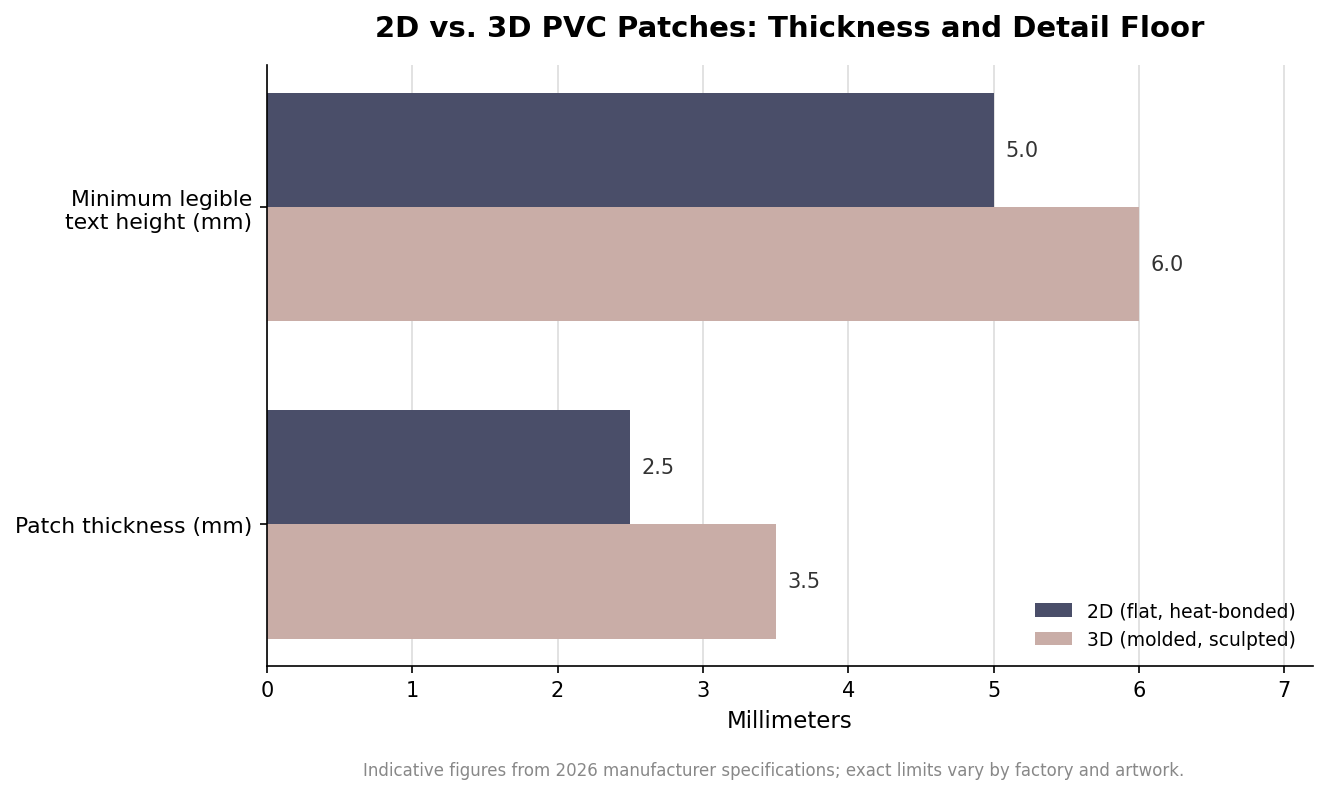
Every PVC patch is either 2D or 3D, and the two are made differently. A 2D patch stacks flat color layers at a uniform height, giving a clean, stepped look at roughly 2.5 millimeters thick. A 3D patch is poured against a sculpted mold so the surface rises and falls in contours, landing closer to 3.5 millimeters, and it typically costs 25 to 40 percent more because the mold is harder to cut. On a hat, 3D reads as more premium and catches light well on a logo with depth, like an animal, a crest, or lettering meant to pop. A 2D patch is the right call for flat wordmarks, flags, and clean graphic logos, where the sculpting adds cost without adding much. Detail floors differ slightly too: legible text runs about 5 millimeters minimum on 2D and closer to 6 on 3D, so a busy 3D design can force the patch larger than a cap front wants.
Backing: how the patch attaches to the cap
Backing is the decision that most changes how the hat gets used, and it is easy to get wrong. Hook-and-loop, the Velcro-style backing, is the choice when the wearer should swap patches; it suits morale caps, tactical hats, and any brand that wants to sell interchangeable designs, and the loop side is sewn to the cap once. Sew-on is the permanent option, with the patch stitched around its border, and it is the standard for structured trucker and dad caps and for beanies, where a hand-stitched edge is the only clean way to attach it. Adhesive or peel-and-stick backing exists but is meant for smooth, hard surfaces rather than fabric, so it is a poor fit for a cap that flexes and gets washed. One common misconception is worth clearing up: PVC patches are generally too thick and heat-sensitive to iron on at home the way an embroidered patch can be, so plan on hook-and-loop or a sewn border rather than a consumer iron-on.
Sizing the patch to the cap front
PVC patches are produced anywhere from about half an inch up to eight inches, but a cap front is a narrow window and the useful range is much tighter. A structured six-panel or trucker front comfortably carries a patch in the two to three inch wide range, tall enough to read but short enough to sit above the seam without curling at the corners. Go much larger and the patch fights the panel’s curve; go much smaller and fine detail collapses, because line work has a floor of roughly one millimeter and the smallest raised elements sit near a third of a millimeter. Standard PVC allows up to eight solid Pantone-matched colors before surcharges, which is more than most cap logos need. The practical move is to design the patch at the exact width of the cap front, confirm the smallest text clears the minimum height, and only then decide between 2D and 3D.
Quantities, price, and lead time
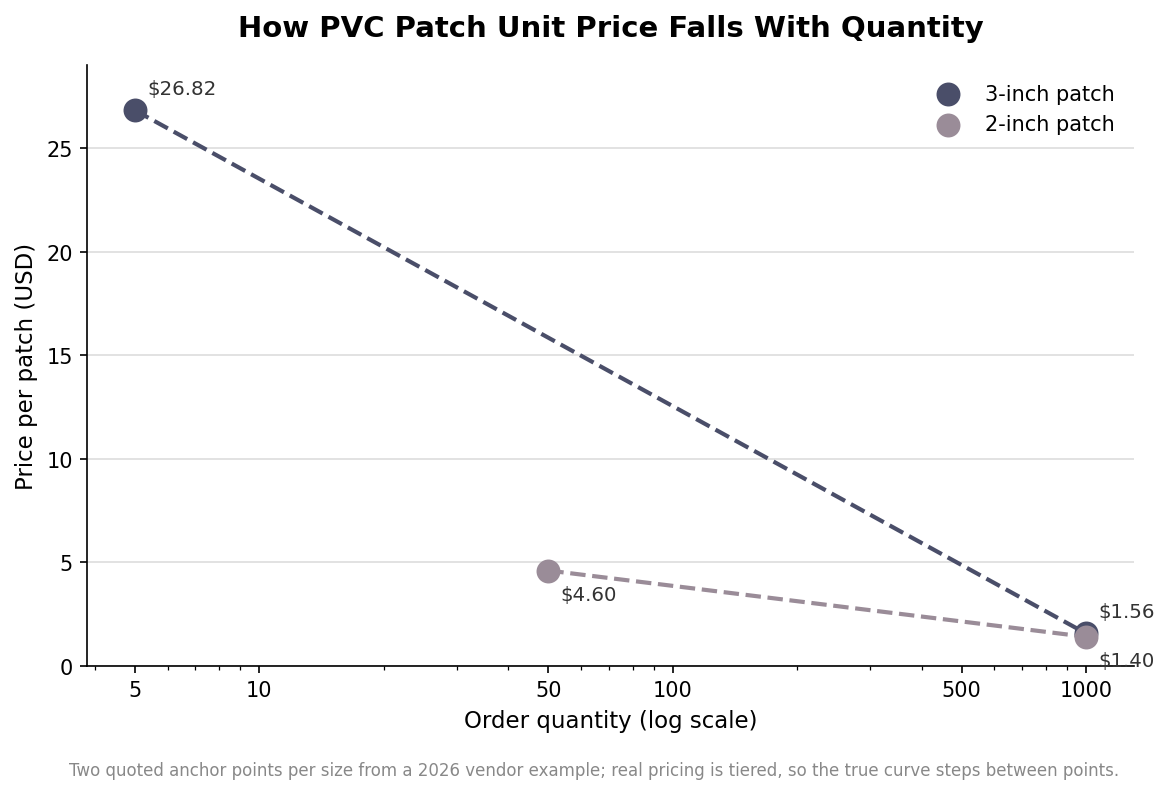
Custom PVC hat patches are approachable in small runs, which is why they suit new brands and one-off events. Minimums are low, commonly in the 5 to 24 piece range depending on the maker, and many suppliers now waive setup, mold, and digitizing fees that used to add up front. Price is where volume tells: one 2026 vendor example put a three inch patch near $26.82 at just five pieces but around $1.56 each at a thousand, while a two inch patch ran about $4.60 at fifty pieces and $1.40 at a thousand. Those are indicative figures from a single quote rather than a universal rate, but the shape is consistent everywhere, a steep drop out of the sample range and a gentle taper after a few hundred units. Turnaround is quick for a decorated product: a digital mockup often lands within a day, and standard production runs about 7 to 14 business days after art approval, with rush service available for a premium. Lock the size and backing to the cap first, approve the mockup, and a batch of PVC hat patches is one of the faster custom pieces you can put on a shelf.