Size is the decision that quietly controls everything else about a custom PVC patch. It sets how much of your artwork survives the mold, whether the text stays readable at arm’s length, what it costs per piece, and whether the finished patch actually sits right on the garment. Get it wrong and you either crowd the design into an unreadable block or float a small logo in the middle of a jacket back. This guide walks through how size is measured, what dimension suits each common placement, and how those inches ripple into your price.
How patch size is actually measured
Almost every patch maker prices and describes size using a single averaged number rather than height and width separately. The industry convention is size = (height + width) / 2. A patch that is 4 inches tall and 2 inches wide is quoted as a 3-inch patch, and a 3.5-inch circle is simply a 3.5-inch patch. This matters because a tall, narrow shield and a wide, short banner can share the same quoted size while looking completely different on the garment, so the averaged figure is a starting point for pricing, not a full description of the shape.
There is a second measurement rule that catches people out at checkout. Many shops bill by the longest dimension, rounded up to the next whole inch. Under that rule a 3-inch and a 3.5-inch patch both land in the 4-inch price tier. If your design sits just over a round number, nudging it down a few tenths of an inch can drop you into a cheaper bracket without any visible loss, which is worth checking before you approve a proof.
Matching size to placement
The single most useful habit is to choose size from where the patch will live, not from the artwork in isolation. A cap and a jacket back are separated by nearly an order of magnitude in usable area, and the sweet spot for each placement is fairly settled across the industry.
Caps and hats are the tightest constraint. A front panel comfortably takes a patch up to about 3 inches, while the curved side and back panels usually want something in the 1.5 to 2 inch range so the patch does not fight the seams. Left-chest logos on polos and work shirts sit best around 3 to 4 inches, the same band that suits most sleeve and shoulder positions. Backpacks and small accent spots read well at 2 to 3 inches. A jacket back is the outlier: designs there typically run 7 to 12 inches, with biker-style back patches often filling the full 11 to 12 inches. Corporate and school logo patches tend to cluster around 3 to 3.5 inches, large enough to hold a wordmark cleanly without dominating the garment.
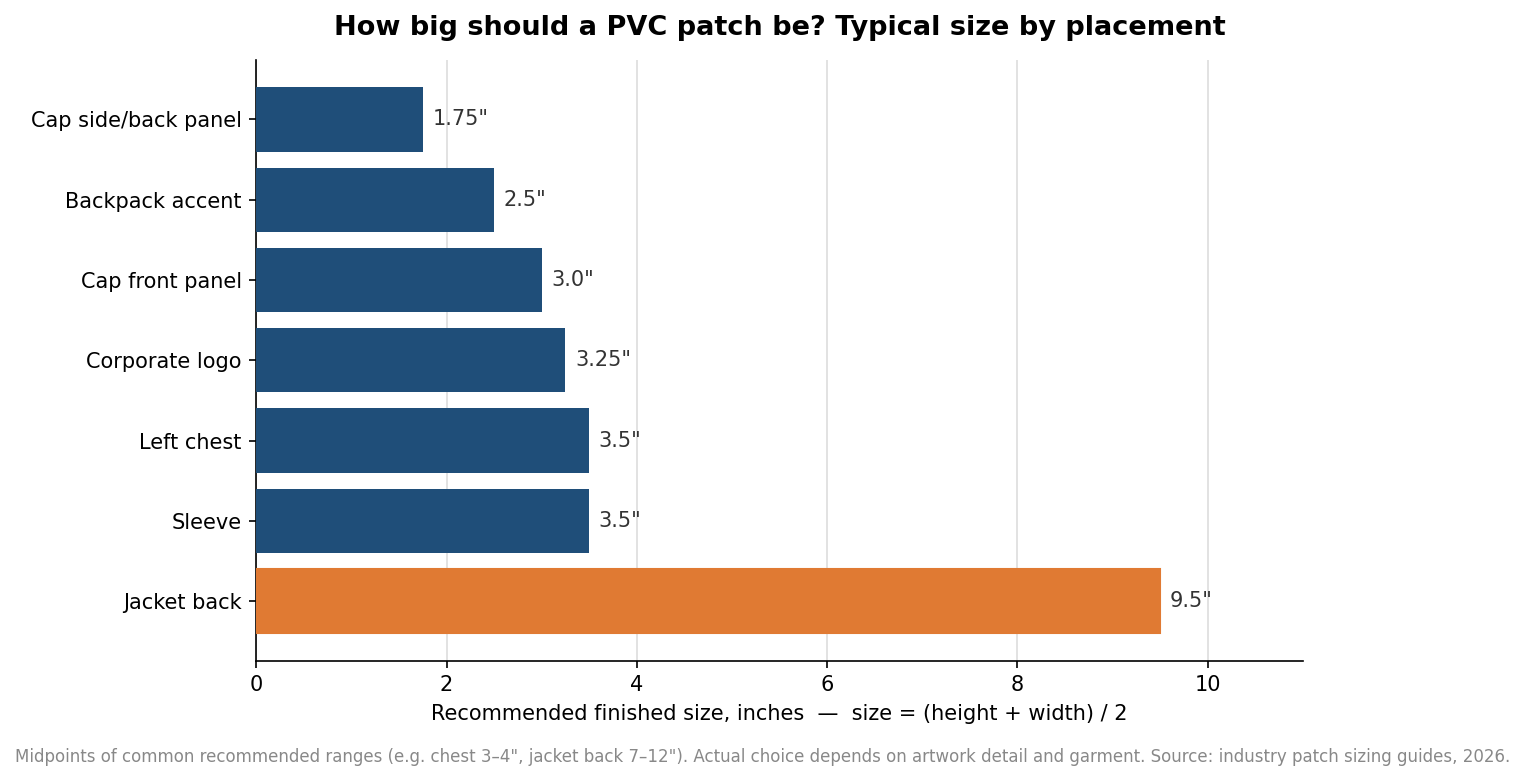
Read the chart as typical midpoints rather than hard limits. The right number within each band depends on how busy your artwork is: a simple two-color emblem holds up at the small end, while a detailed crest with fine linework needs the extra room. When you are unsure, size up by a quarter inch rather than down, because PVC holds detail better with a little breathing space.
Where legibility sets the floor
PVC is molded rather than stitched, so it can carry finer detail than embroidery, but there is still a practical floor set by how small text and thin lines can go before they disappear. As a working rule, keep any text at least a quarter inch tall in the finished patch. That single constraint often decides your minimum size. A logo with a tagline underneath may look balanced on screen, but if shrinking it to 2 inches pushes the tagline below a quarter inch, the words turn into a smear of raised rubber.
Two moves solve most legibility problems. The first is to simplify: drop the smallest tier of text, thicken hairline strokes, and increase the gap between elements so the mold has clean separation to reproduce. The second is to accept a slightly larger patch. Going from 2 inches to 3 inches gives you more than double the usable area, which is usually cheaper and less frustrating than fighting to cram a full logo into a coaster-sized footprint. If a design simply cannot be simplified, let the readable-text rule pick the size for you.
How size and quantity move the price
Two levers set what you pay per patch: how big it is and how many you order. Size feeds the per-piece rate through the rounding rule above, so a jump from a 3-inch to a 4.5-inch patch moves you up a tier or two. Quantity is the larger lever by far, because the fixed costs of setting up a run get spread across every piece.
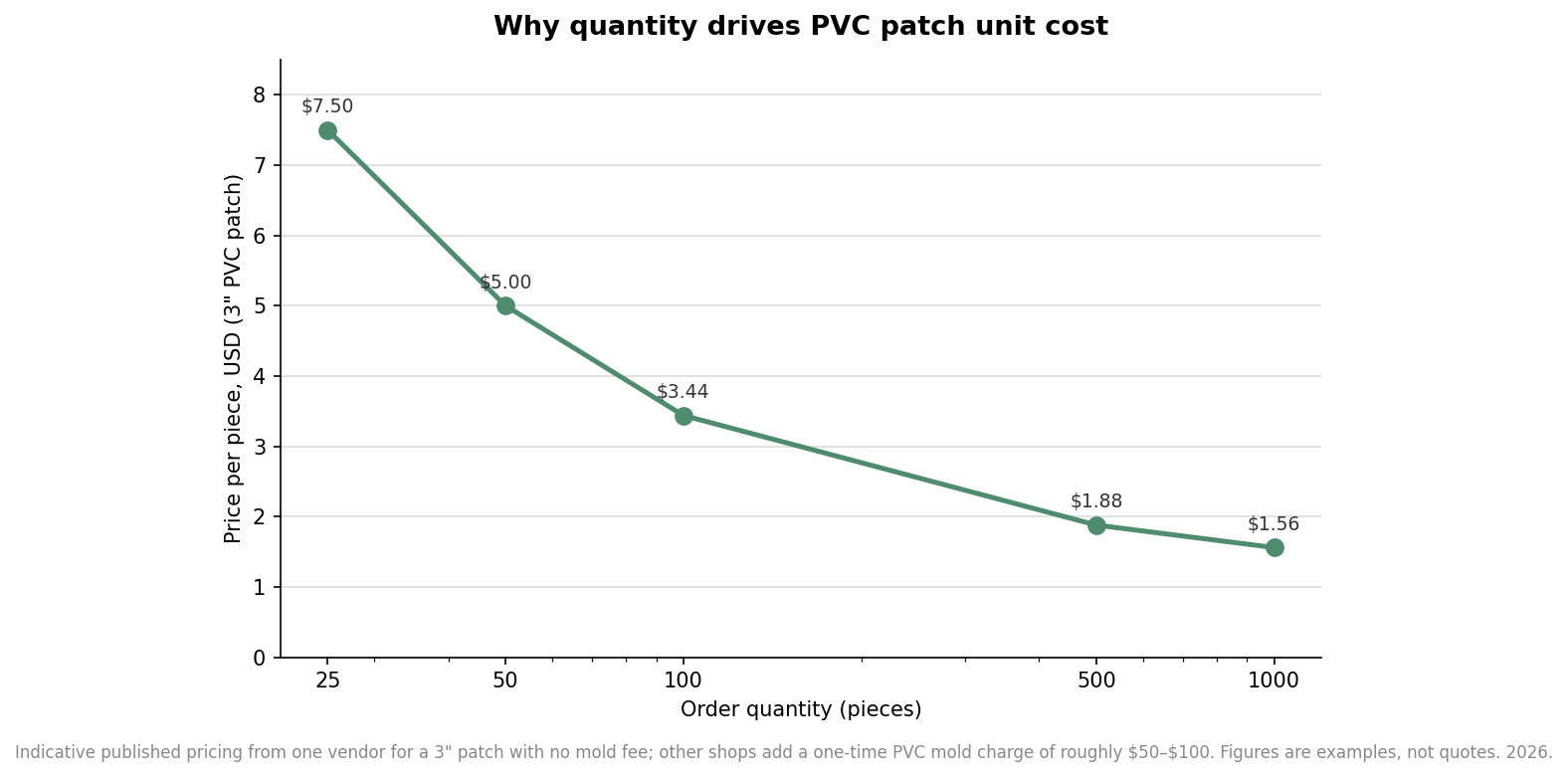
The curve above shows why small runs feel expensive. Indicative published pricing for a 3-inch PVC patch runs around \$7.50 each at 25 pieces but roughly \$1.56 each at 1,000, an almost fivefold drop driven entirely by volume. The exact numbers vary by shop and are examples rather than quotes, but the shape holds everywhere: the steepest savings come in the first few hundred units, then the line flattens. If you expect to reorder, it is often cheaper per piece to commit to a larger single run than to place two small ones.
One line item to confirm separately is the mold or tooling fee. PVC patches are made from a custom mold, and some suppliers charge a one-time setup fee in the neighborhood of \$50 to \$100 for it while others fold that cost into the per-piece price. On a run of 50, a \$75 mold fee adds \$1.50 to every patch, which can quietly double your effective unit cost, so always ask whether a quoted price is all-inclusive before you compare vendors.
Specifying size on your order
When you place the order, give the size as explicit height and width in inches for your primary shape, and note the placement so the shop understands the intent. Saying “3.5 inches wide for a left chest” is far clearer than “medium,” and it lets the proof come back at the dimension you actually need. Ask for the digital mockup to show the finished size against a reference, confirm that your smallest text clears the quarter-inch floor, and check which price tier your longest dimension lands in. Standard PVC production typically runs about 7 to 14 business days after you approve the proof, with a digital mockup usually available within a day, so building in a little schedule margin for one revision is wise. Nail the size first and the rest of the order tends to fall into place.