Soft PVC is among the most physically durable patch materials on the market, and it is also the most flexible when it comes to special effects — glow, reflective, translucent, glitter. Those two facts are related. Because a PVC patch is essentially a small molded piece of pigmented rubber rather than stitched thread, a factory can build extra behavior into the material itself. Understanding how the patch is made explains both why it survives years of abuse and how each special finish actually works, which is what you need to know before you ask for one.
How a soft PVC patch is actually made
Every PVC patch starts as a reverse-image mold. A CNC machine cuts your artwork into a steel or aluminum block, carving each color area to a set depth — roughly 2 to 4 millimeters for a flat 2D patch, and up to about 8 millimeters for a sculpted 3D design. The material itself is a blend of PVC powder and a liquid plasticizer, mixed at around a four-to-one ratio with color pigment and heated to about 175 to 180 degrees Celsius until it flows. A technician, or an automated dispenser that can handle roughly a dozen colors at once, deposits each color into its cavity in sequence and lets each layer set before the next so the colors do not bleed. The filled mold is then heat-cured in stages, commonly fifteen to twenty minutes in a first pass and another ten to fifteen at full temperature, with longer rests between layers on complex multi-color designs. Once cooled to room temperature, the finished patch is demolded, trimmed, and fitted with a backing such as hook-and-loop, adhesive, or sew-on.
That process is why the color sits in the patch rather than on top of it. There is no ink layer to scratch off and no thread to fray, which sets up everything the material does well.
Why the material lasts
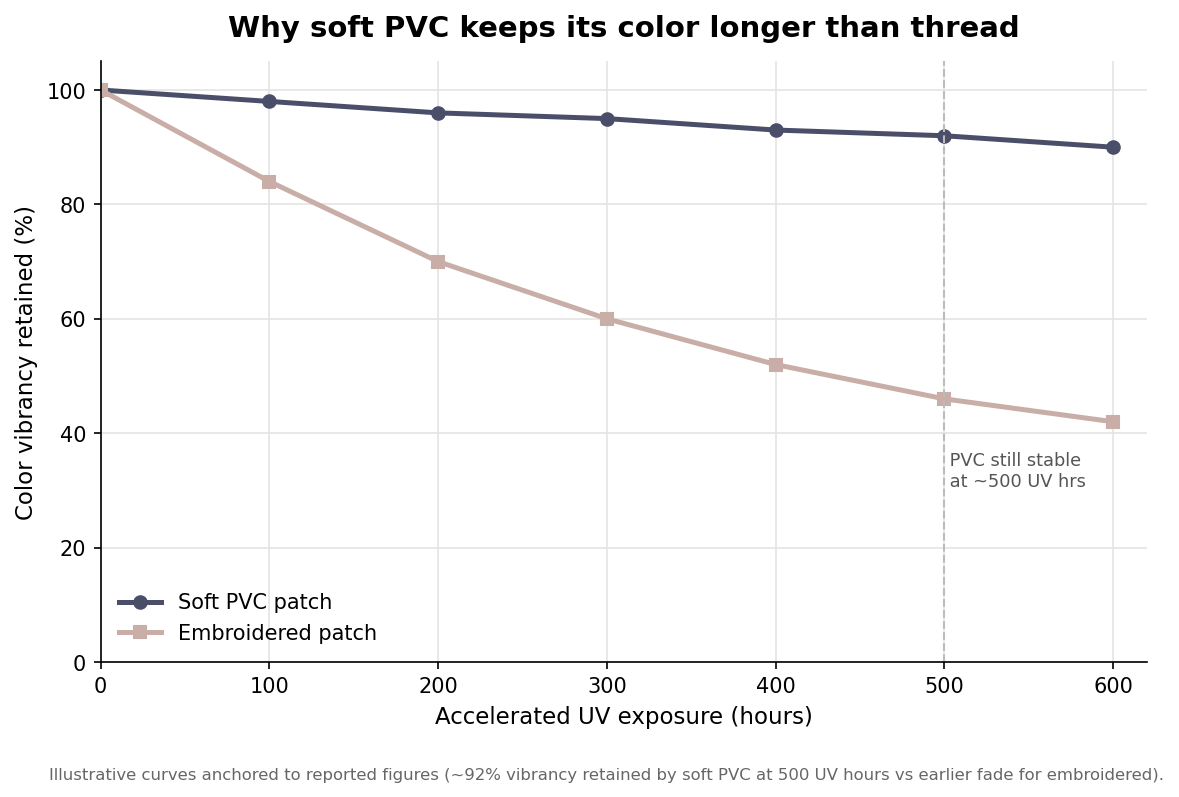
The payoff of a solid molded body is durability that embroidery cannot match. Because cured PVC is non-porous, it is genuinely waterproof — moisture cannot wick in, so there is nothing to fade, rot, or grow mildew, and the surface shrugs off oils, solvents, and cleaning chemicals. In accelerated weathering, a well-made soft PVC patch holds around 92 percent of its color vibrancy and stays stable well past 500 hours of UV exposure, roughly two and a half times the point where an embroidered patch has visibly faded. Wash testing tells the same story: a PVC patch typically endures 100 or more laundry cycles and five-plus years of hard field use, against one to two years for a fabric patch. For gear that lives outdoors — packs, plate carriers, work jackets, caps — that gap is the entire reason the material exists.
Glow in the dark: the pigment decides everything
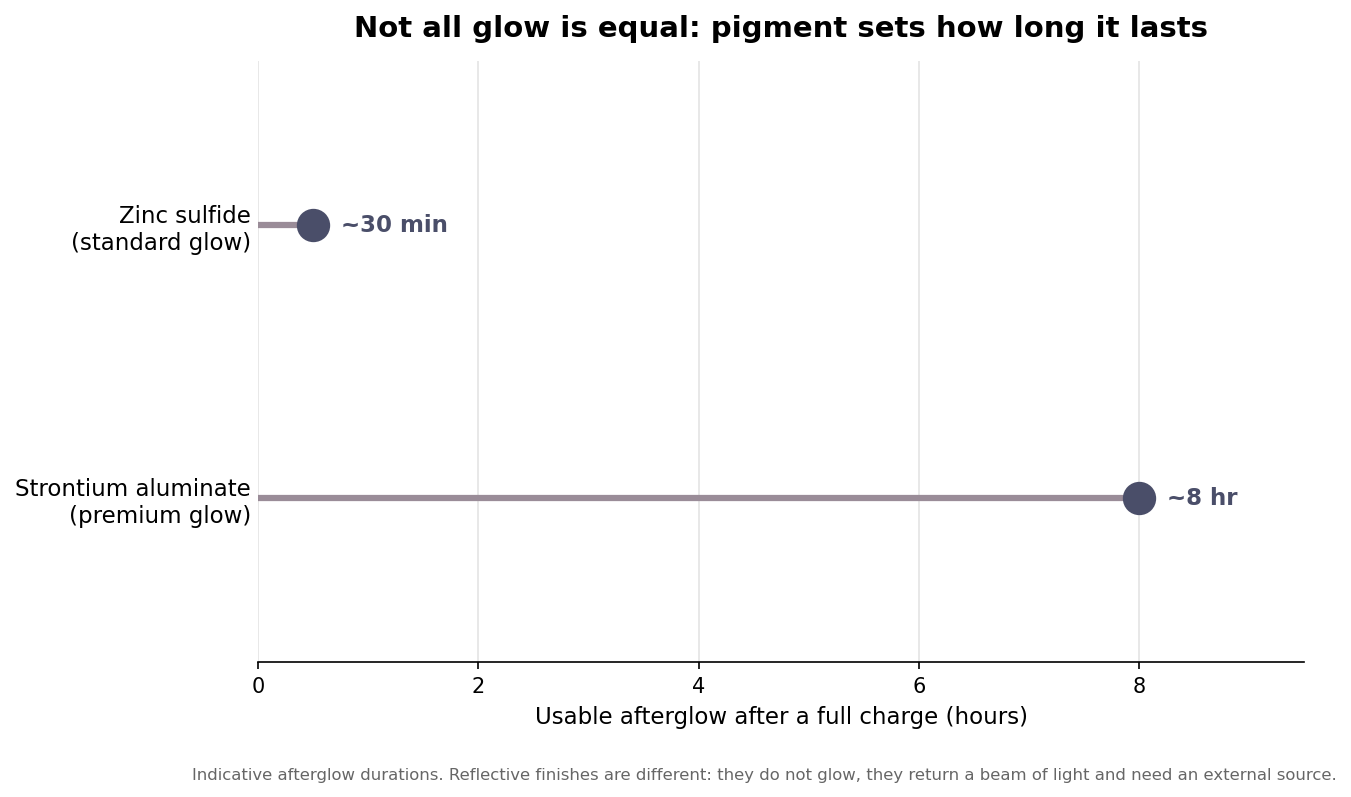
A glow-in-the-dark patch works by mixing a photoluminescent powder into the liquid PVC before it cures, so the whole glowing area is charged with light and then releases it slowly in the dark. The critical decision, and the one most buyers never think to ask about, is which pigment. Zinc sulfide is the older, cheaper option: it charges in a couple of minutes and glows a familiar green, but its usable afterglow is short, measured in minutes rather than hours. Strontium aluminate is brighter and lasts far longer — a strong charge can carry a visible glow for hours — which is why it is worth specifying by name when the glow is a real feature rather than a novelty. In daylight both tend to look pale or off-white in the glowing areas, so plan the daytime design around that. Glow reads best as a discrete element — an outline, a symbol, lettering — set against normal opaque colors, rather than trying to make an entire patch glow uniformly.
Reflective and hi-vis: a different kind of visibility
Reflective patches are often confused with glow, but they do the opposite thing. A reflective finish does not store and release light; it returns light straight back toward whatever source hits it, which is why a reflective patch looks ordinary in a dark room but flares brightly the instant a flashlight or a car’s headlights sweep across it. That makes it the right choice for anyone who needs to be seen by someone holding a light — roadside crews, cyclists, search-and-rescue, security — where a mark that only shows at distance under a beam is exactly the point. The trade-off is that reflective areas read as flat gray in daylight and do nothing at all without an external light. Some designs combine both: a reflective border for headlight visibility plus a glow element that works in total darkness. If both matter, say so up front, because they are separate materials placed in separate areas of the mold.
Specifying a special finish without surprises
A few habits keep a special-finish order from disappointing. Name the glow pigment you want rather than accepting a generic “glow” spec, since the difference between minutes and hours of afterglow comes down to that single line. Keep the special element as a defined zone in the artwork so the factory can place it cleanly, and remember that glowing and reflective areas will look different in daylight than an on-screen proof suggests. Ask for a pre-production sample and test it the way it will actually be used — charge the glow under a lamp and check it in a dark room, or hit the reflective version with a phone flashlight from across a room. Special finishes rarely add much to the per-piece price, but they do add a variable that a two-minute test will confirm before you commit to a full run.